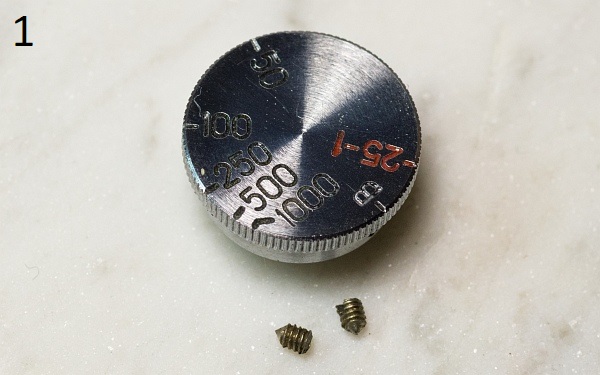
The speeds disk with the two grub screws.
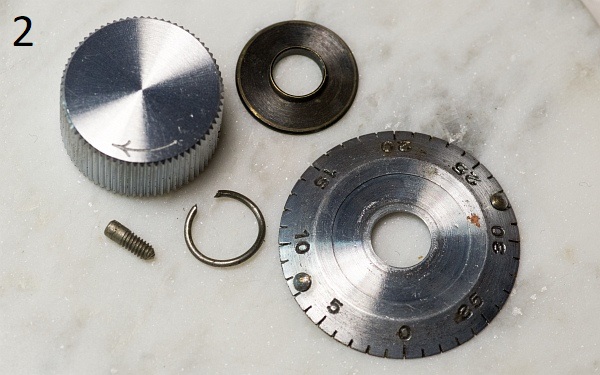
The winding knob in its individual parts. The small round spring is clipped onto the bottom of the winding knob. It slows down the film counter wheel. Lightly grease the washer during installation.
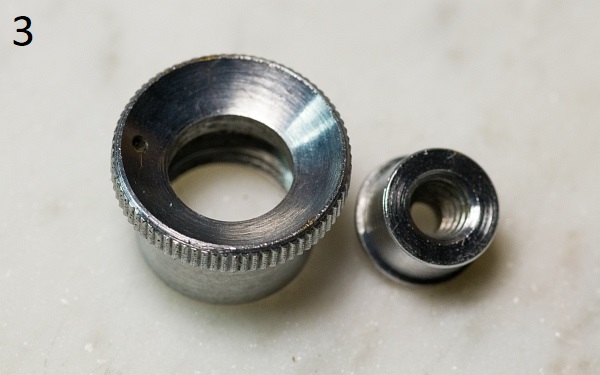
The release button and the collar around it.
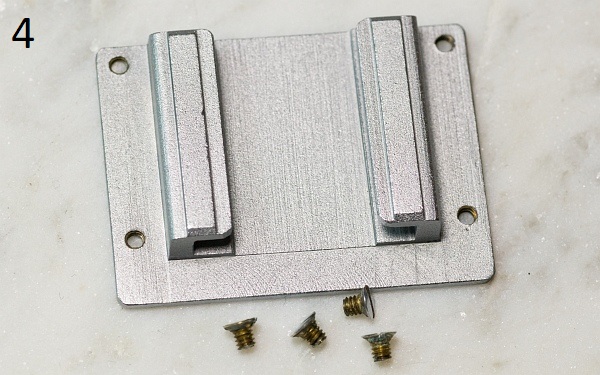
The accessory shoe. Actually, you don't have to remove it.
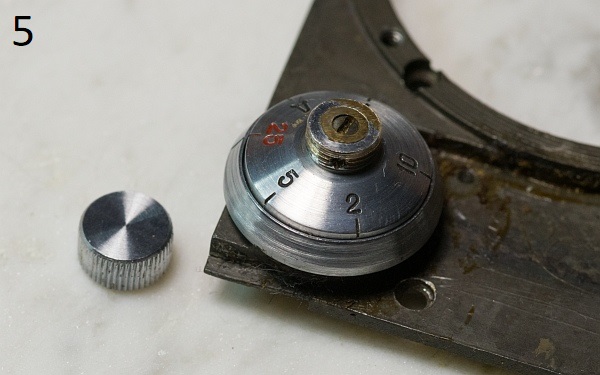
The slow-speed button. Inside, you can see the screw used to set the slow-speed settings. Turning it to the right increases the set time, turning it to the left decreases it.
You can also take it apart and unscrew it, but here the tiny grub screw inside was also broken and would have had to be drilled out. You don't necessarily have such small grub screws in stock, so I removed the front plate together with the knob.
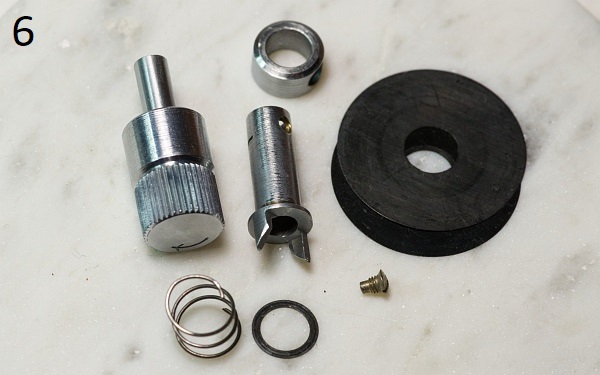
All parts of the rewind crank. The small washer at the bottom is needed to prevent the spring from slipping over the fork.
The silver ring at the top has a beveled side. This must face downwards during installation, otherwise the screw will not fit properly.
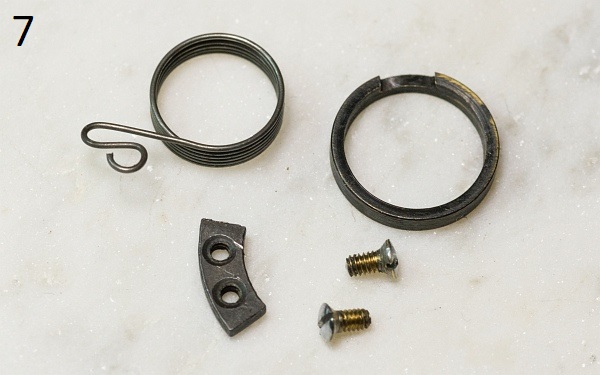
Parts of the tensioning mechanism. The spring prevents the tensioned shutter from unwinding automatically. The ring has a recess into which the arm of the spring must fit. When installed, the holes in the threaded plate fit exactly over the two eyelets of the spring.
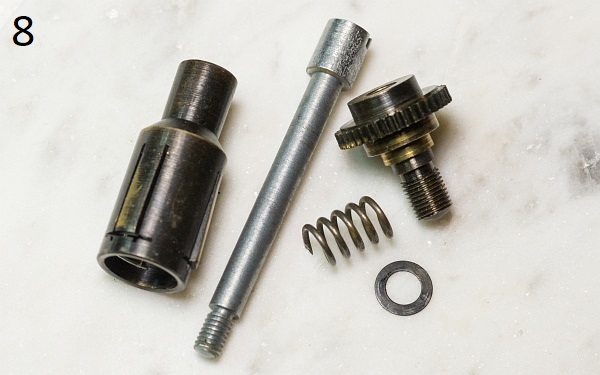
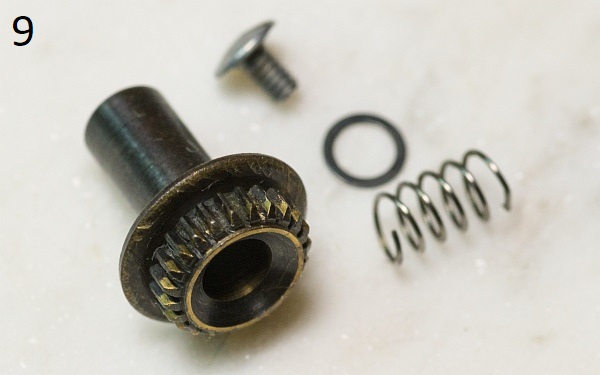
Additional parts of the tensioning mechanism. The winding knob is screwed onto the gear wheel. The large sleeve holds the film take-up spool. If the spool is too loose or too tight, the contact pressure can be adjusted by bending the three tabs.
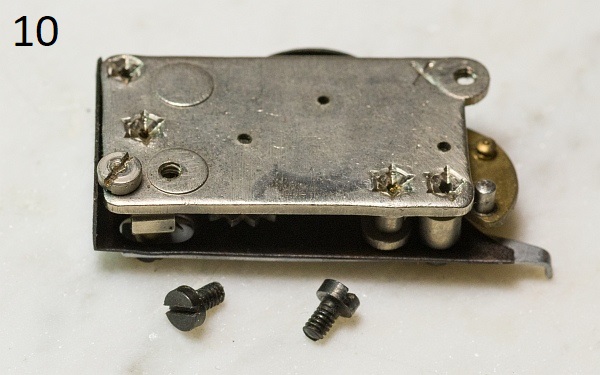
Parts of the rewind lock. When the lever at the top is turned toward "B" the wedge-shaped part (see 16) lifts the gear wheel and releases the gear mechanism at the top. The spring ensures that the gear wheel returns to the gear mechanism when the lever at the top is reset.
The slow-speed mechanism. At the bottom, you can see the slider that is moved by the slow-speeds button when setting 1/10 sec. There is a small spring on the right side of the oval part. It must end behind the brass-colored knob. If it slips out, the mechanism will not work.
If it is difficult to move, you can bathe it in benzine and push the oval part backwards to trigger the slow-speed mechanism.
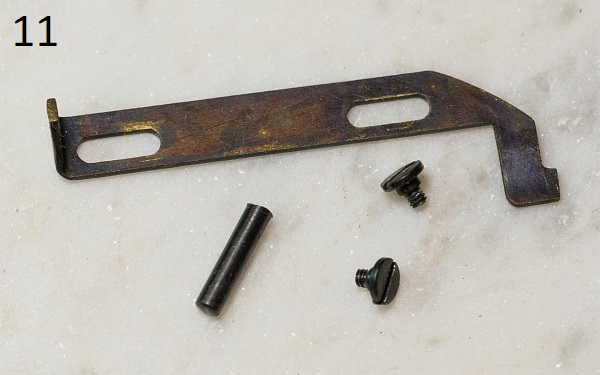
Further parts of the rewind lock. The raised gear wheel from 9 also pushes this rod downwards. This pushes out a small pin at the bottom and releases the lower gear, allowing the film to be rewound.
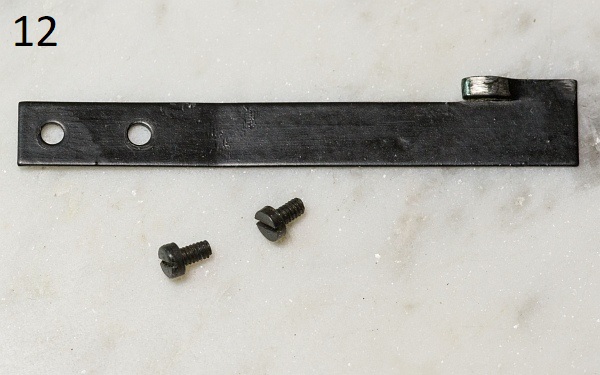
This leaf spring is for the slow-speed mechanism. Note the small bump at the top right. In conjunction with the comma-shaped disc (21), it moves the rod of the slow-speed mechanism upwards.
This raises the small plate at the top of the long-exposure lever rod after the first curtain has been triggered and has run its course. It then gets in the way of the driver under the speed disc (19), preventing the second curtain from running until the slow-speed mechanism has run its course.
When the camera is cocked again, the disc moves down from the leaf spring, moving approximately one millimeter downward, allowing the tiny spring at the top of 24 to push the slow-speed lever back down so that it does not collide with the driver at the top.
No wonder such a complicated slow-speed mechanism did not catch on. It is quite susceptible to dirt and therefore prone to errors.
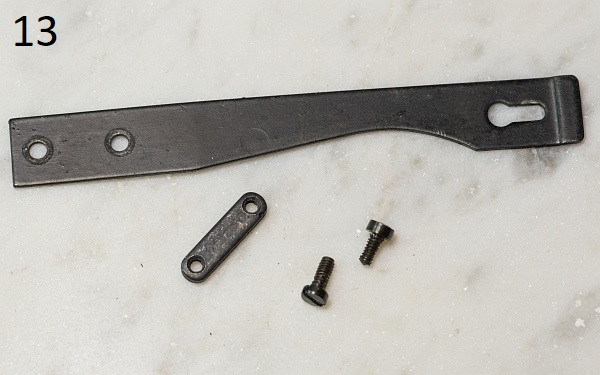
The release spring for the shutter. Attaching the small threaded plate on the inside can be a test of patience.
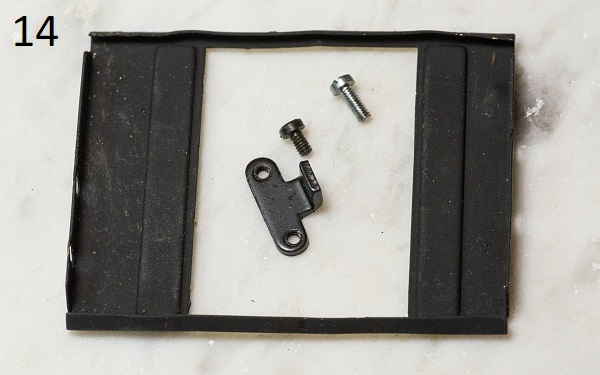
The light trap with the 36x24mm cutout of the film format. It shares a screw with the rangefinder on the top and one with the slow-speed mechanism on the bottom.
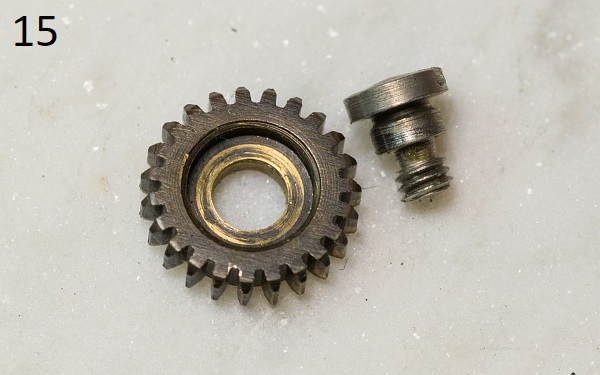
The small gear wheel of the transmission. Some grease should be applied between the screw and the gear wheel.
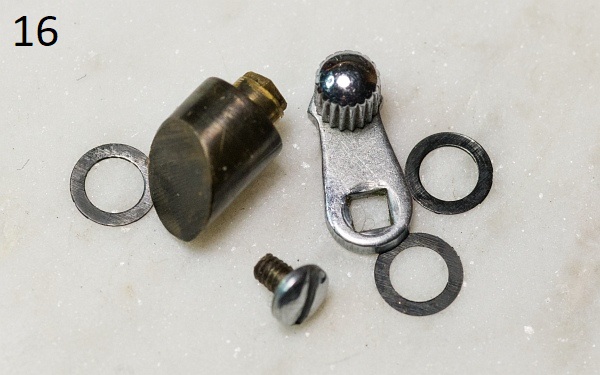
The parts of the rewind lock on the top. The number and position of the washers is important during installation. Otherwise, the lever will be too stiff or too loose.
The wedge-shaped part moves the gear with the spring (see 9) so that the film can be rewound.
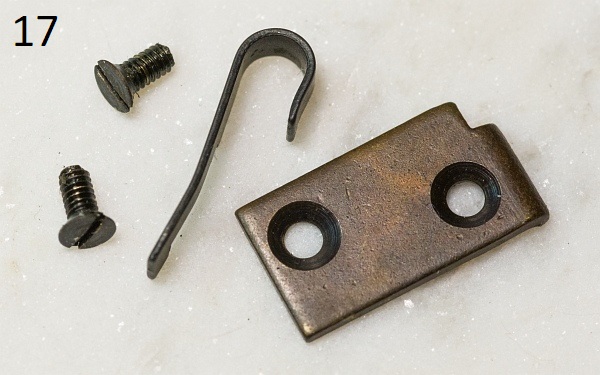
Parts of the brake on the first curtain. The curtain is braked so that it does not trigger so loudly. On the other hand, there can be the rare effect that the first curtain snaps back after triggering and the image is then overexposed at the edges.
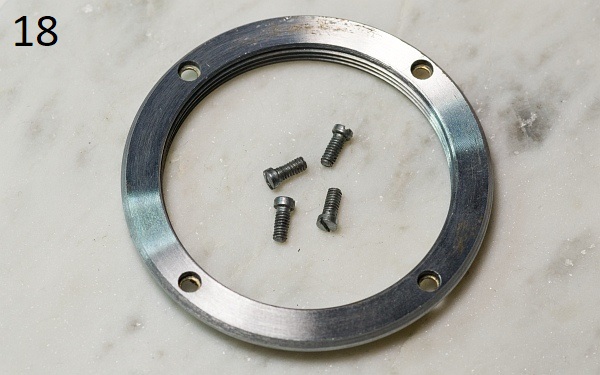
The screw mount with fastening screws. Before doing this, the wax paper strips must be repositioned correctly.
A small tip for tightening the screws: use your finger to prevent the screwdriver from slipping inward. I've had the screwdriver slip before and end up in the shutter cloth...
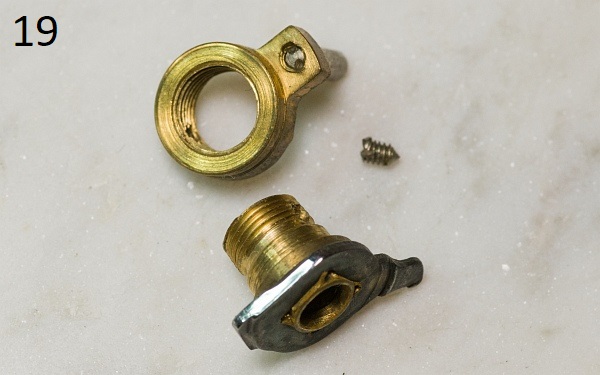
The defective part, now replaced by a working one. Unfortunately, this part is only used in the Zorki 3. The cam at the bottom is necessary for the slow-speed mechanism to work. This means that parts from other Zorki cameras cannot be used.
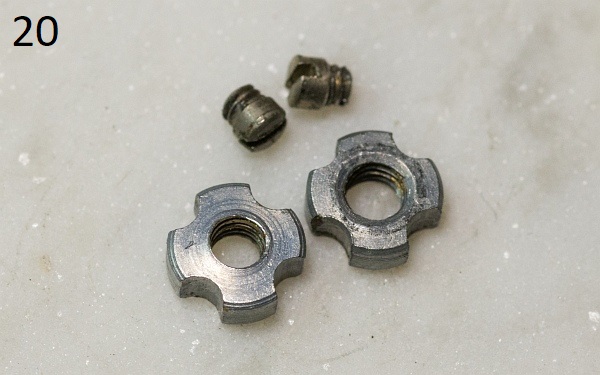
The tension nuts of the shutter springs and their fixing screws. The tension nuts have left-hand threads!
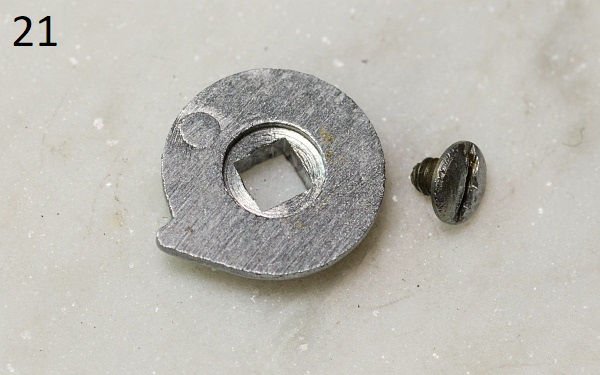
The comma-shaped disc. For explanations, see 12.
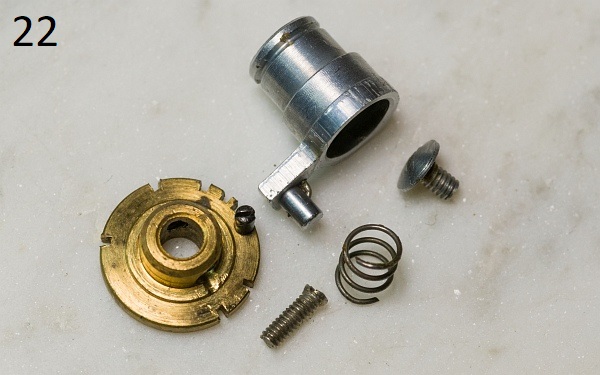
Parts of the speed control. Slots are milled into the brass disc, into which the rear part of the pin of the silver knob snaps into place.
The long grub screw is annoying. Sometimes it goes back in very easily and sometimes it becomes a test of patience.
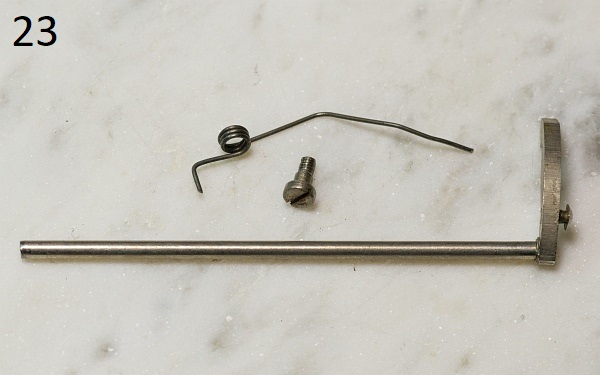
The speed delay lever and its spring. Inserting it is often annoying, as it has to fit into a hole at the bottom of the case back.
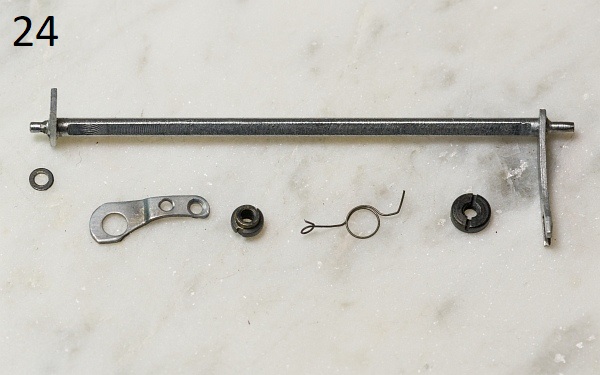
The slow-speed lever and its parts. There are some very small and unique parts that should not be lost in the carpet.
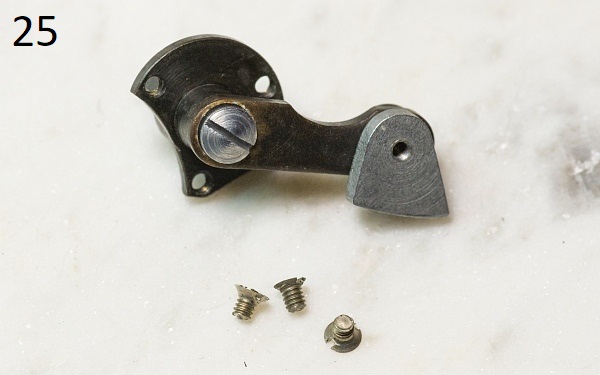
The rangefinder arm is attached so that the straight side of the plate with the 3 threads faces the housing wall.
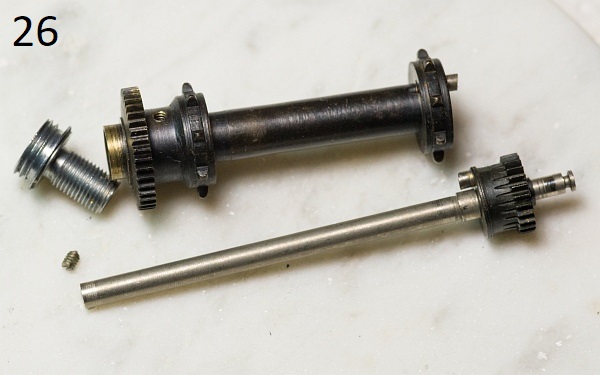
Spiked roller and release gear wheel. The spiked roller is screwed in place from above and below and then secured with the grub screw. The rod with the gear wheel is inserted into the spiked roller when the shutter is installed.
When released, the rod is pressed down and releases the locked shutter, which can now run down.
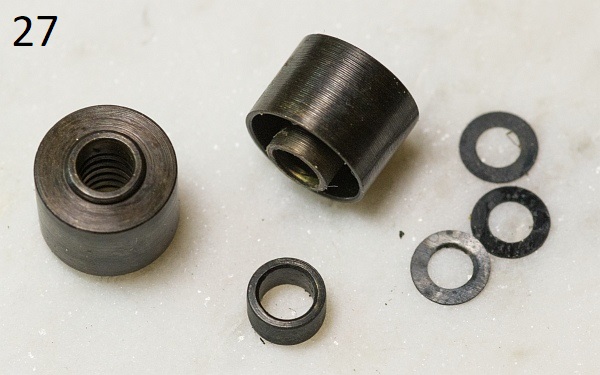
The shutter straps run over the rollers. The small sleeve is a spacer. It is rare to see that small washers have been used for readjustment.
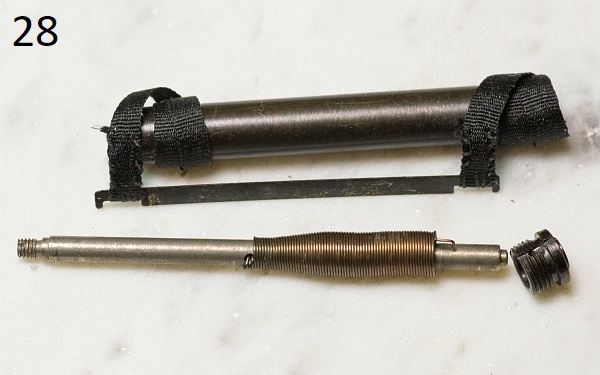
Tension spring and roller of the second curtain. The tension spring is hooked into a small recess in the part at the bottom right.
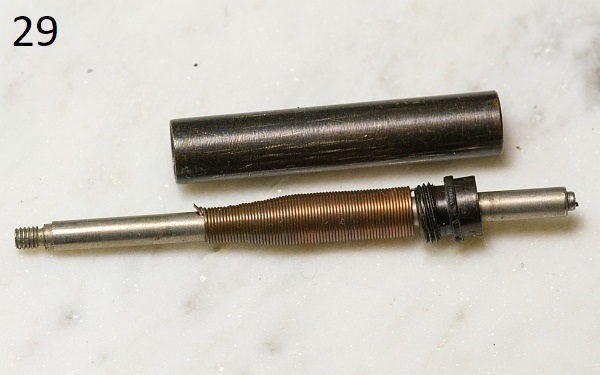
Tension spring and roller of the first curtain. As you can see, the tension springs are attached to different points on the axle. Be careful not to mix them up when assembling.
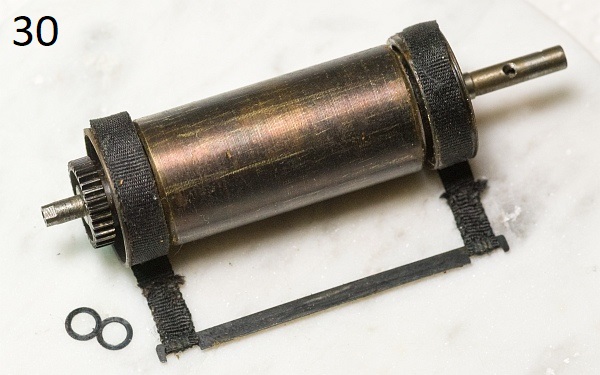
The large drum. The first curtain is attached to the bar, and the longer cloth of the second curtain is glued to the drum. There are almost always 1 to 3 small washers on the axle.
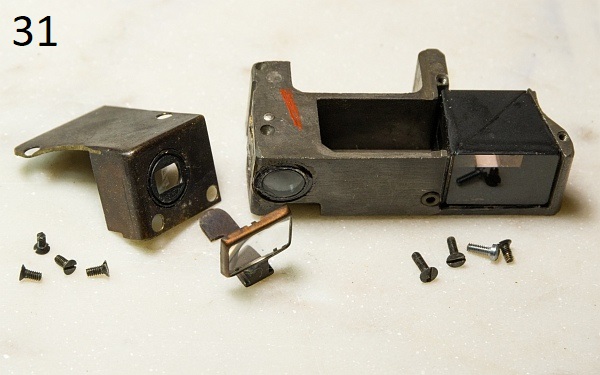
The parts of the rangefinder, roughly disassembled. On the left is the cover with the outer lens, and at the front is the movable diopter adjustment. When disassembled like this, it is easy to access the lenses and clean them.
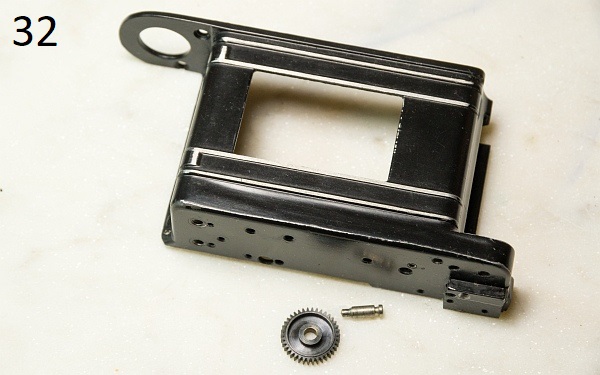
The shutter case from behind. All parts except one have been removed.
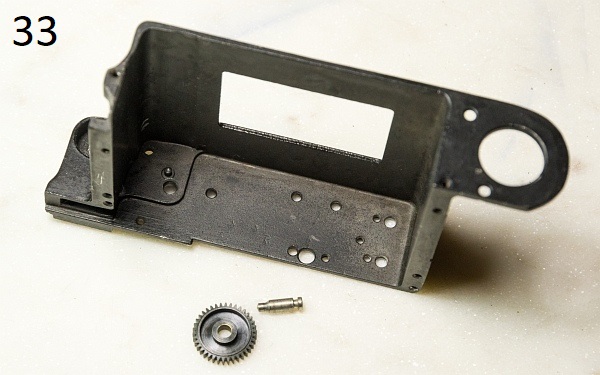
The shutter box from the inside. You can clearly see the numerous drill holes and threads.
At the bottom, you can see the now freely rotating gear wheel that is attached to the shutter, together with the pin that is simply pushed through the axle of the gear wheel. Finally, no more miserably stuck screws, as was the case with the older Zorkis.
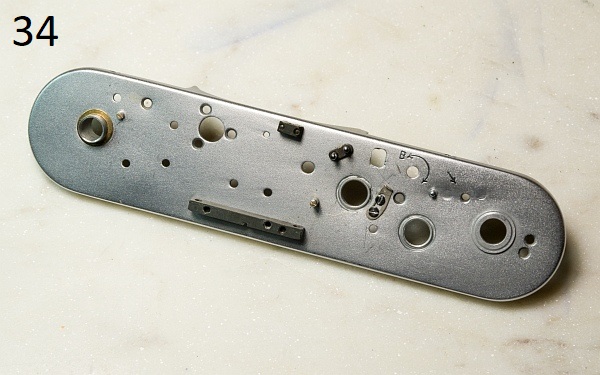
The cover plate. Everything except for a few parts has been dismantled. Here, too, a remarkable number of drill holes can be seen.